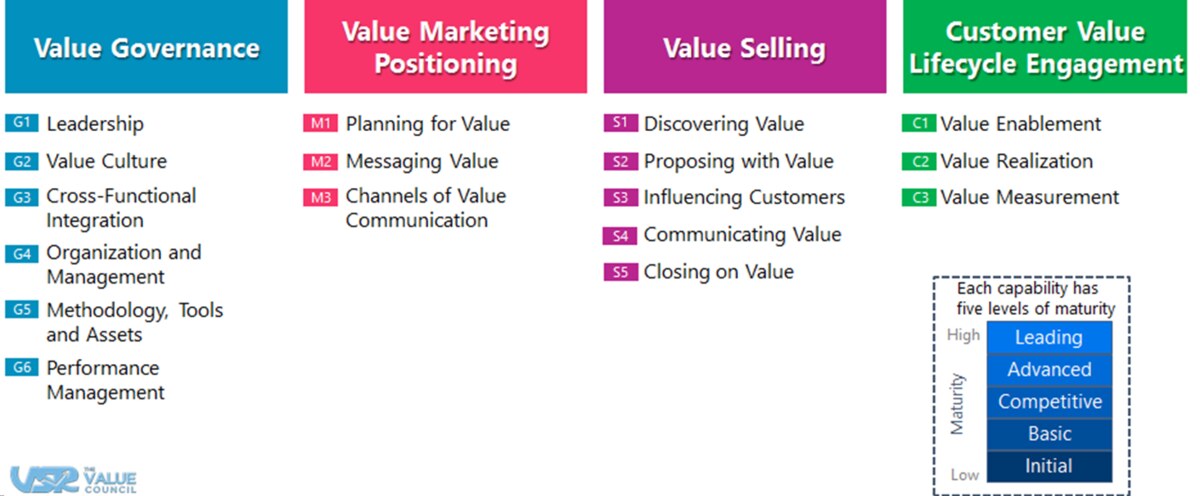
The four categories
What each category assesses
Each category reduces to a question a leadership team can answer honestly, and to observable signals of strength and gaps.
Value Governance
Who owns value, and how are decisions held to account?
Value governance covers the ownership, decision rights, standards and reporting that keep value claims honest. It defines who approves a business case, which measures are used, how benefits are tracked after approval, and how the organisation learns when outcomes differ from expectations.
Signals of strength
- A named owner for value standards and benefit reporting
- One agreed value and business-case method across teams
- Post-decision benefit reviews that feed future investment choices
Signals of gaps
- Every team builds its own business-case template
- Benefits are approved but never revisited
- No one can say whether last year's investments delivered
Value Marketing & Positioning
Does the market hear outcomes, or features?
Value marketing and positioning is the discipline of expressing what an organisation does in the language of customer outcomes. It covers value propositions, proof, reference evidence, pricing narrative and the consistency between what marketing promises and what delivery can demonstrate.
Signals of strength
- Positioning framed around measurable customer outcomes
- Reference evidence and case material tied to real metrics
- Consistent value language from campaign to contract
Signals of gaps
- Messaging leads with capability lists
- Claims that delivery teams cannot substantiate
- Value stories that stop at the point of sale
Value Selling
Can teams build and defend a credible business case with the buyer?
Value selling capability is the ability of client-facing teams to diagnose a customer's situation, quantify the cost of inaction, build a defensible business case with the customer's own numbers, and carry that case through the buying committee to a decision.
Signals of strength
- Discovery that produces baselines, not just requirements
- Business cases co-authored with the customer's finance stakeholders
- Consistent quantification tools and coaching in the sales process
Signals of gaps
- Business cases created late and only when asked for
- Discounting used in place of a value argument
- Wide variation in quality between individual sellers
Customer Value Engagement
Is expected value tracked, adopted and proven after the decision?
Customer value engagement is the ongoing, joint work of turning an agreed business case into realized outcomes: shared success measures, adoption support, periodic value reviews, and evidence that the expected benefits either arrived or were corrected in time.
Signals of strength
- A carried-forward baseline from business case to delivery
- Scheduled joint value reviews with the customer
- Realized outcomes documented and reused as evidence
Signals of gaps
- The business case is never opened again after signature
- Adoption measured by logins rather than outcomes
- Renewal conversations with no proof of delivered value